Efficiency: Doing More with Purpose in the Medium Term
Business, Ecology, and Technology Efficiency
The evolution of the advertising, media, and economic landscapes has accelerated industry-level and organizational disruption. Maintaining efficiency in this environment is incredibly important, but what that means is not straightforward. For an organization to work efficiently, it needs to be nimble yet set a course through inevitable medium-term changes (some known, others unknown). By defining a strategy through the lens of efficiency, organizations can balance outcomes and costs, and address the operational and economic realities of today while positioning for sustainable growth.
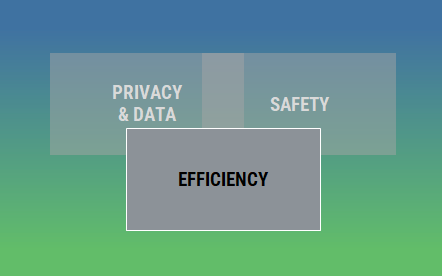
At the core of this approach are three key areas – business, ecology, and technology – that must be considered separately to maximize their own value, and holistically to maximize overall efficiency. The combination of these three, if done well, can create competitive advantage, employee satisfaction, and a medium to long-term strategy that will endure macro shifts, expected or otherwise.
Business Efficiency as a Defensive and Offensive Strategy
In a down economy, businesses often hunker down, focusing on cost-cutting measures and streamlining operations. This current-quarter defensive approach is a survival instinct, supporting resilience during challenging times. But what if business efficiency could be more than just a defensive strategy? What if it could be a potent offense when conditions begin to brighten?
Efficiency is not just about doing more with less; it’s about doing more with purpose. When companies optimize their resources and processes during tough economic periods, they position themselves to seize opportunities when growth returns. How you structure teams matters more than ever. Data and technological advancements can empower teams and individuals but the complexity of the landscape also means that there are shared responsibilities across an organization that must be managed to ensure efficiency and compliance. For example, if a company wants to set a more eco-friendly strategy, that imperative is only as strong as its weakest link, so it requires cross-team ownership.
Too often, the overall ownership of discrete strategies or initiatives is overlooked, delegated, or shared to the point of overlap or finger pointing. Establishing clear responsibility, accountability, and processes for core projects is essential in the quest for efficiency. A thoughtful organizational design strategy that contemplates your resources today and the tomorrow that you are building towards can make or break your next quarter, year, or beyond. With that in place, streamlined operations and reduced waste can make your business agile and ready to capitalize on emerging trends.
The Eco-Efficiency Imperative
Simultaneously, the imperative of ecological efficiency cannot be overlooked. Consumer preference for ecology-friendly products and services is driving brands to reduce emissions – and inefficient advertising is one of the components to manage.
Optimizing for ecological efficiency isn’t just a matter of environmental responsibility; it’s also a smart financial move. Businesses that reduce their environmental footprint today are not only better prepared for future compliance costs and potential fines but also benefit from immediate cost savings. Direct initiatives (less so offsets) to achieve resource efficiency and sustainability can lead to significant reductions in energy consumption, waste generation, and resource depletion, resulting in lower operational costs.
Furthermore, as other organizations create their own ecological strategies, and demand their partners meet a certain bar in terms of sustainability practices, advanced businesses can capitalize on being further down that path, potentially winning business and appealing to a wider audience vs. their less progressive competitors – all while doing the right thing. Investment in terms of resources, education and organizational-wide support (or even incentives) are important factors for success, alongside demanding more from partners and others that make up the ecosystem.
The Crucial Role of Technology – and Measurement
To achieve the level of efficiency required for success today, it is often necessary to reevaluate legacy tools and systems. Outdated systems can hinder an organization’s ability to assess and execute optimizations. Modernizing systems involves redesigning processes, incorporating automation, and leveraging emerging technology, such as artificial intelligence and privacy-enhancing technologies. Regularly evaluating the latest systems and solutions will also be instructive for overall partner strategies. By taking advantage of the full set of tools available, businesses can eliminate bottlenecks, reduce errors, and enhance overall operational efficiency.
Efficiency in all forms relies on accurate, comprehensive measurement and analysis tools and practices. Tools must provide actionable insights that contribute to better decision-making and outcomes – and similar to the concept of cross-team ownership above, the chain is only as strong as the weakest link. Technology and reporting will often rely on third parties to uphold their end of the bargain, so that data inputs and outputs flow correctly and decisions can be made across the entire supply chain and partner network. Understanding and aligning to partner methodologies, roadmaps and priorities will ensure greater mid-term success.
When end-to-end technologies and practices are designed and applied holistically, the resulting data will not remain confined to reports and dashboards but will actively shape business strategies. For instance, real-time monitoring and analysis of energy usage can prompt immediate adjustments to reduce costs, while supply chain optimization tools can enhance ad delivery and client satisfaction.
Efficiency: Convergence in the Medium Term
Business, ecological, and technology efficiency is a strategic imperative for enterprises in the advertising and media spaces. They can be at odds in the short term, but they support each other – and a healthy ecosystem – in the medium term.
Business efficiency serves as both a defensive shield during economic downturns and a powerful offensive weapon when conditions improve, creating workflow and structural changes that reduce wasted effort. Simultaneously, ecological efficiency ensures long-term sustainability and cost savings, potentially creating a competitive advantage. Finally, the journey towards efficiency hinges on the modernization of legacy systems and on accurate measurement tools, enabling organizations to navigate the complex and dynamic landscape of the medium term with confidence and purpose.
How can ThinkMedium help you with one or more aspects of efficiency?